
DFW Real Estate Leads Amid Market Normalization
Industry News, Real Estate Trends, Dallas–Fort Worth
DFW Real Estate Outpaces the Nation Amid Market Normalization
The Dallas–Fort Worth market is cooling from its pandemic-era frenzy, yet it continues to outperform most of the country. Here’s how industry news and on-the-ground trends reveal a market that’s normalizing—without losing its edge.
Industry News & Trends: From Red-Hot to Refreshingly Normal
Across the U.S., real estate headlines have shifted from bidding wars to buzzwords like “balance,” “normalization,” and “price discovery.” Dallas–Fort Worth (DFW) is a textbook example of this new phase. Sales activity remains robust, but the pace is saner, pricing is more disciplined, and buyers are finally regaining leverage in select segments.
In June 2026, closed home sales in the metroplex climbed about 6.5% year-over-year, according to MetroTex data (dfwagentmagazine.com). Yet median prices held essentially flat around the low-$400,000s, a sign of healthy demand meeting a less frantic, more rational market. Nationally, many metros are still wrestling with steeper price declines or sluggish sales—making DFW’s combination of volume and stability a standout.
Broader data from the Dallas Federal Reserve echoes this story of normalization. Dallas shows a modest 1.5% year-over-year price decline, while Fort Worth is essentially flat at –0.1%, with both markets projected to rebound by early 2027 with price growth in the 3%–4% range (dallasfed.org). In other words, the market is catching its breath—not collapsing.
📌 Key Takeaway: Industry reports show DFW shifting from a runaway seller’s market to a more sustainable, balanced environment—without giving up its long-term growth trajectory.
How DFW Residential Real Estate Is Outpacing the Nation
On the residential side, DFW continues to rank among the country’s most active housing markets. June 2026 data shows nearly 9,000 home sales, placing the metro second nationally in transaction volume (homes.com). While some markets are seeing sharp price corrections, DFW’s median home price has held in a relatively tight band—roughly $395,000 to $410,000—over the past year (opendoor.com).
That resilience is underpinned by a strong regional economy. Job growth is running at about 1.6% annualized, unemployment hovers near 3.9%, and average hourly earnings are competitive with national figures (dallasfed.org). Employers continue to add roles across tech, logistics, healthcare, and professional services—keeping demand for housing steady even as higher interest rates cool speculative buying.
At the same time, inventory is finally catching up. Active listings are up roughly 10% year-over-year, and more than one in five homes has seen a price reduction (realtor.com). In Prosper alone, local observers note more than 1,100 homes on the market, especially in the $500K–$600K range, where properties are taking months—not days—to sell. By contrast, more affordable neighborhoods in Tarrant County still see homes in the $250K–$400K range move in under 35 days.
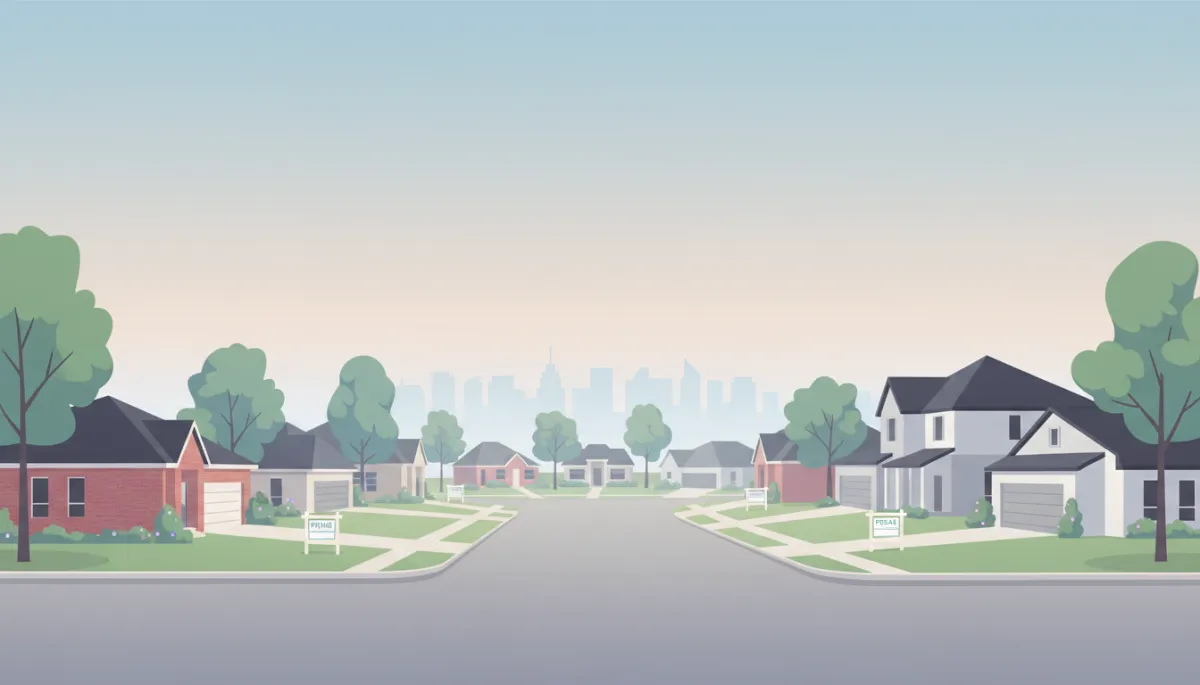
Rising inventory and longer listing times are giving DFW buyers room to negotiate.
This hyper-local divergence is the hallmark of a normalizing market. Entry-level and mid-range homes in well-located neighborhoods are still competitive. Higher-priced suburban listings, particularly in areas that saw rapid construction, are adjusting to a more selective pool of buyers. Sellers who cling to 2022 pricing expectations are watching their homes sit; those who price realistically are still closing near 96% of list price in many Collin County submarkets.
💡 For Buyers: The days of waiving every contingency are largely over. With more choices and motivated sellers, especially in the $500K–$800K bracket, buyers can focus on value, condition, and long-term fit instead of simply “winning” the house.
Commercial Real Estate: A National Standout for Investment
While residential headlines get most of the attention, industry news makes it clear that DFW’s commercial sector is where the metro truly outpaces the nation. The region ranks #1 nationally for commercial real estate investment appeal in 2026, according to ULI/PwC’s Emerging Trends in Real Estate report (pwc.com).
Industrial and retail are the clear bright spots. Industrial leasing absorbed more than 12 million square feet in early 2026, the strongest performance since 2022, and vacancy has tightened to around 10%. Retail centers, particularly in growing exurbs and formerly quiet towns such as Terrell, are at or near record occupancy as rooftops attract restaurants, services, and daily-needs retail (272holdings.com; dallasfed.org).
The office story is more nuanced, mirroring national trends but with a DFW twist. Overall vacancy remains elevated, yet Class A “trophy” assets in prime locations are seeing renewed interest as companies right-size and seek higher-quality spaces. Class B and C buildings, on the other hand, face structural headwinds and may require repositioning or conversion to stay relevant. Even here, DFW’s diversified job base and population growth give it a stronger foundation than many coastal peers.
What Market Normalization Means for the Next 12–18 Months
Looking ahead, most forecasts point to a period of modest, sustainable growth. After an estimated 5% price dip in 2025, DFW home values are expected to grow roughly 3%–4% annually into early 2027 as mortgage rates ease slightly and wages continue to rise (mdregroup.com; dallasfed.org).
For sellers, that means the strategy is shifting from “list it and wait for the stampede” to pricing smart and presenting well. Clean, move-in-ready homes in desirable school zones should still attract strong offers. Overpriced or dated properties, however, are likely to linger as buyers compare more options and insist on value.
For buyers and investors, normalization is an opportunity. There is more time for due diligence, more room to negotiate concessions, and more clarity around true market value. In a metro where both residential and commercial fundamentals remain among the strongest in the country, that combination of stability and leverage is rare—and worth watching closely.
📌 Bottom Line: DFW is no longer a runaway train—but it is still ahead of the pack. As the market normalizes, the metro’s scale, economic diversity, and investment appeal position it to keep outpacing the nation in the next stage of the real estate cycle.
