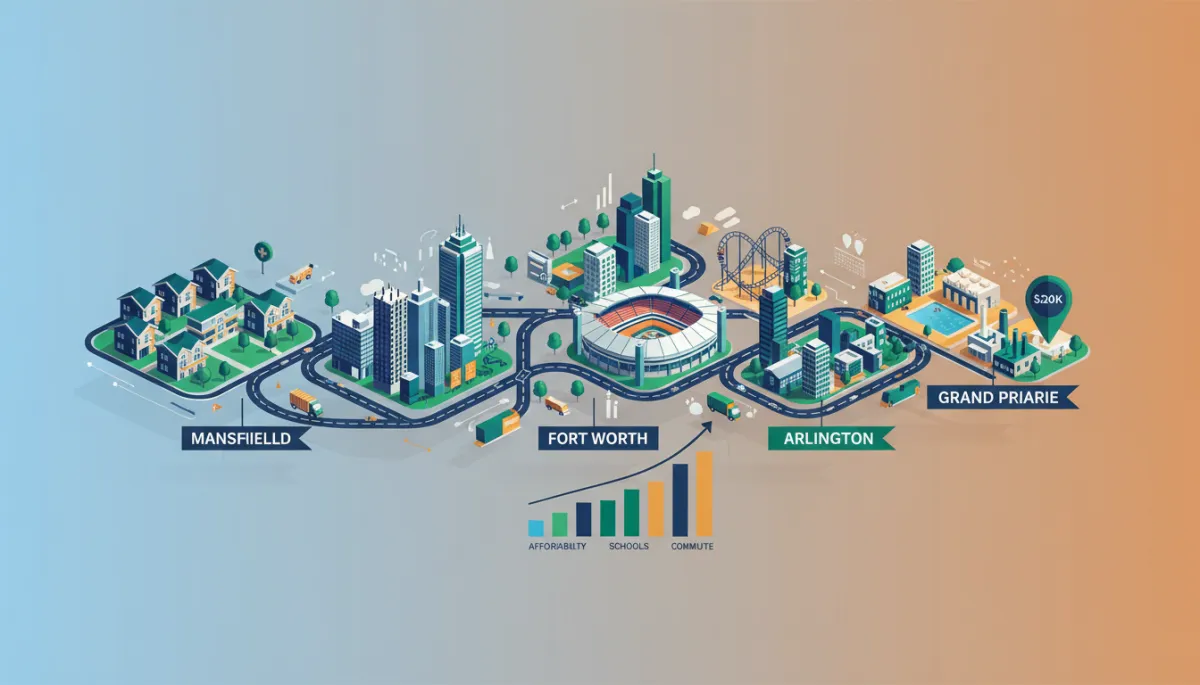
North Texas Growth: Mansfield to Grand Prairie
North Texas, Real Estate, Population Growth, DFW Suburbs
North Texas Growth Corridors: Why Mansfield, Fort Worth, Arlington, and Grand Prairie Lead the West DFW Boom
As North Texas races toward 9 million residents, the western and southern suburbs of Dallas–Fort Worth are quietly becoming the region’s next great growth story. Mansfield, Fort Worth, Arlington, and Grand Prairie form a powerful corridor where middle-market affordability, strategic location, major infrastructure investments, and large-scale land development are reshaping how and where people live, work, and play.
Mansfield: High-Income Growth Hub with Top Schools and Destination Development
Mansfield has evolved from a quiet suburb into one of North Texas’s most desirable high-income growth hubs. Families are drawn by top-rated schools, master-planned neighborhoods, and a lifestyle that feels upscale yet attainable compared with many north-side Dallas suburbs. The city is doubling down on that appeal through ambitious mixed-use, healthcare, and retail projects.
Downtown, the Watermill District is transforming the historic core with restaurants, offices, multifamily units, and structured parking—an urban-style destination in a suburban setting. Along TX‑360, the $2.5 billion Staybolt Street entertainment district, anchored by a multi-sport stadium, hotels, and boardwalk-style public spaces, positions Mansfield as a regional entertainment and healthcare magnet. City-backed investments in parks and street infrastructure, funded through bonds and Tax Increment Reinvestment Zones, further support long-term growth and rising home values.
Fort Worth: Population Giant with Room to Run and Industrial Momentum
Fort Worth is already one of America’s fastest-growing big cities, adding more than 22,700 residents in a single year, according to recent NCTCOG estimates. Unlike land-constrained Dallas, Fort Worth still has vast room for outward expansion and annexation, especially in the emerging “Westoplex” corridor to the west and north. This outer-loop potential is a major advantage for builders, employers, and homebuyers seeking space and value.
The city’s growth engine is powered by logistics and industrial development. From Alliance and Northlake to the south and west, major distribution centers, manufacturing facilities, and data centers are clustering along highway and rail corridors, helping drive some of the highest industrial absorption in DFW. Inside the loop, projects like the proposed Panther Island high-rise and new infill zoning tools are setting the stage for more urban living options near downtown and the Stockyards, broadening Fort Worth’s appeal to both young professionals and relocating families.
Arlington: Infill Powerhouse and Entertainment Engine with Accessible Prices
Positioned squarely between Dallas and Fort Worth, Arlington is the ultimate infill city—largely built out, but actively reinventing key corridors through higher-density, mixed-use redevelopment. It is already home to the Cowboys, Rangers, and a growing cluster of theme parks and attractions, and the next wave of billion-dollar entertainment expansions is underway.
The Anthem redevelopment of Lincoln Square and a new downtown mixed-use project with hundreds of apartments and ground-floor retail will add housing, restaurants, and walkable amenities near major stadiums and job centers. At the same time, Arlington’s home prices remain relatively accessible for middle-market buyers compared with many northern suburbs, making it attractive to first-time buyers, young families, and investors who want central access without urban premium pricing.
Grand Prairie: Central Logistics and Resort Hub with Attainable Values
Straddling the heart of DFW’s freeway network, Grand Prairie has emerged as a central logistics and resort-style hub. With median home values hovering around $320,000, it offers a compelling value proposition for buyers priced out of trendier northern suburbs but still seeking quality neighborhoods and reasonable commutes to both Dallas and Fort Worth.
Large-scale developments like the Goodland and Lakesong master-planned communities are opening thousands of new lots, while the EpicCentral district, new hotels, and Andretti Indoor Karting and Games build on the city’s entertainment identity. On the employment side, expansions such as Halperns’ Steak & Seafood, Cutter & Buck, and new fulfillment and manufacturing facilities reinforce Grand Prairie’s role as a jobs-rich industrial node with strong long-term demand for nearby housing.
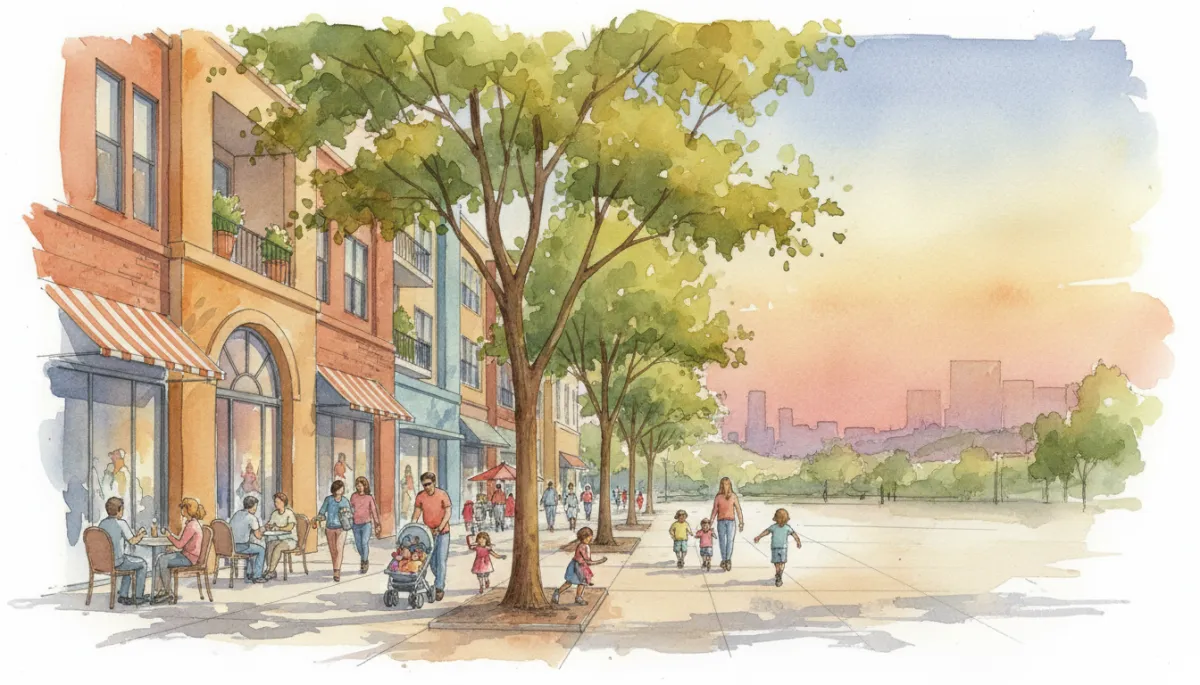
Mixed-use districts in Mansfield, Arlington, and Fort Worth add lifestyle amenities that support long-term housing demand.
How These Corridors Compare to the Broader DFW Market
Across DFW, the housing market has cooled from its peak, with prices flattening after years of rapid gains. Yet Mansfield, Fort Worth, Arlington, and Grand Prairie offer a distinct mix of price points, growth types, and buyer profiles that set them apart from higher-cost northern suburbs and denser Dallas infill neighborhoods.
Price points: Median values in Grand Prairie and many Fort Worth submarkets remain comfortably in the low-to-mid $300,000s, while Mansfield and Arlington offer move-up homes and new construction that still undercut comparable product in Collin and Denton counties.
Growth types: Fort Worth and Grand Prairie lean into logistics and industrial job growth; Mansfield combines high-income residential with healthcare and entertainment; Arlington focuses on infill redevelopment and world-class entertainment districts.
Buyer profiles: These cities attract a blend of first-time buyers, relocating families seeking strong schools, and investors chasing rent-ready inventory near job centers and entertainment.
Inventory advantages: Compared with land-tight Dallas and some northern suburbs, there is more room for new subdivisions, master-planned communities, and mixed-use districts, which helps keep options—and prices—more balanced.
The Structural Backbone of DFW’s Next Chapter
As North Texas marches toward a projected 12.4 million residents by 2050, cities like Fort Worth, Mansfield, Arlington, and Grand Prairie are not just riding the wave—they are forming the structural backbone of DFW’s population expansion. Their combination of affordability, strong schools, major job centers, and manageable commutes offers a compelling alternative to increasingly expensive and congested core markets.
For households and investors alike, these west-and-south corridors represent where North Texas is heading next: more connected, more diversified, and more accessible—without sacrificing quality of life.
